


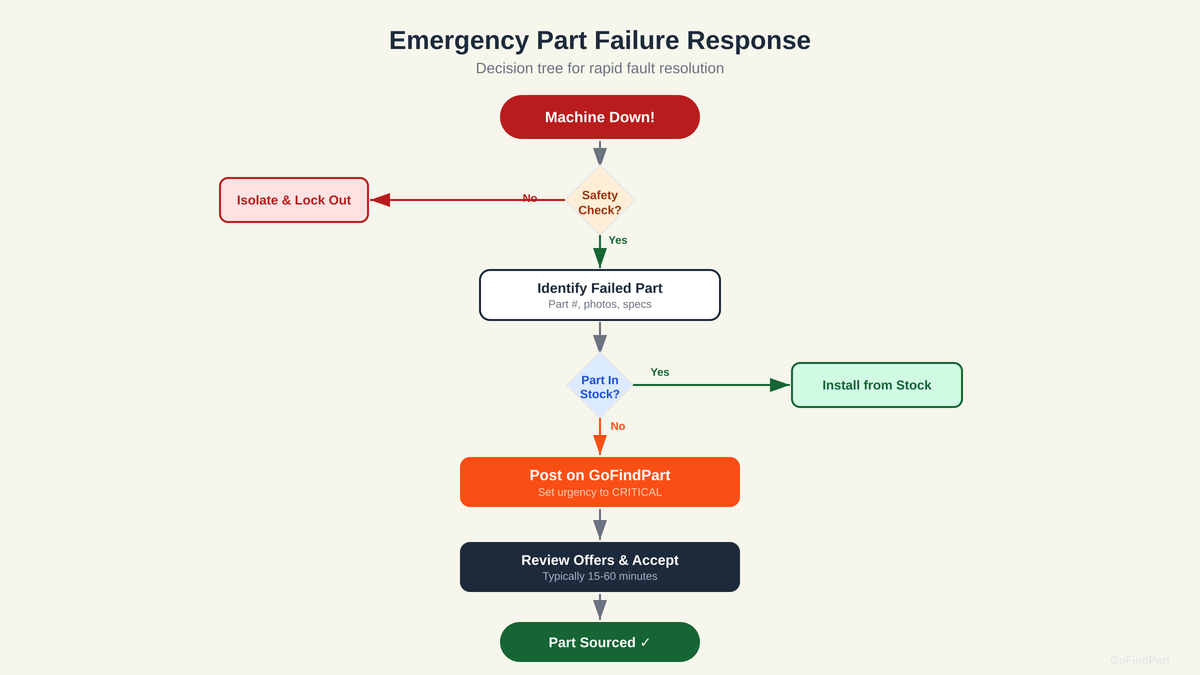
Safety first. Before touching any failed bearing or its housing, ensure the machine is fully isolated and locked out. Failed bearings can be extremely hot, and seized components may release suddenly when disturbed.
A bearing failure rarely gives warning. One moment the machine is running normally; the next, there is an unmistakable grinding noise, vibration spike, or sudden seizure. When a critical bearing fails, your immediate actions determine whether you are looking at hours of downtime or days.
This guide is designed to be read during an emergency. It covers what to do in the first five minutes, how to identify the exact replacement you need, and how to source it as fast as possible.
Error
Immediate Actions (First 5 Minutes)

Stop the machine immediately if it has not already seized. Continued operation with a failed bearing causes cascading damage to shafts, housings, and adjacent components. Isolate the machine electrically and apply lockout/tagout procedures.
Assess the damage visually. Can you see the failed bearing? Is the housing intact? Is the shaft still straight? These observations determine whether you need just a bearing replacement or a more extensive repair. Photograph everything — these images will help suppliers identify the correct replacement.
Warning
Check for collateral damage. A seized bearing can bend a shaft, crack a housing, or damage seals. Replacing only the bearing when the shaft is damaged will result in premature failure of the new bearing. Measure shaft runout with a dial indicator before reassembly.

Identifying the Correct Replacement
Every bearing has a designation number that encodes its type, dimensions, and features. For example, SKF 6205-2RS tells you it is a single-row deep groove ball bearing (6), medium series (2), 25mm bore (05), with rubber seals on both sides (2RS).
If the nameplate or marking is illegible, measure the bore diameter (inner ring), outer diameter, and width with a vernier calliper. These three dimensions uniquely identify most standard bearings. Cross-reference with a manufacturer catalogue or an online bearing lookup tool.
Note the seal type (open, shielded, sealed), cage material (steel, brass, polymer), and any special features like stainless steel construction or food-grade lubrication. Getting these details right the first time prevents costly re-orders.
Sourcing the Replacement Fast
Once you have the bearing specification, time is critical. Post a CRITICAL urgency request with the exact bearing designation, quantity, seal type, and any cross-reference numbers you have identified. Include photographs if the marking is partially legible — experienced sellers can often identify bearings from partial information.
For a CRITICAL request, every wave of seller notifications goes out within 15 minutes of posting, so stockists of common bearings like 6200-series deep groove ball bearings see your request almost immediately. Specialist bearings — large bore, high-temperature, or application-specific types — may take longer to source, but a reverse auction still reaches far more potential suppliers than working through a distributor call list.
Bearing Failed? Get Offers Now
Post a CRITICAL request and receive competitive offers from verified bearing suppliers within minutes.
Post Emergency Request

