


If the motor failure was accompanied by smoke, burning smell, or visible arcing, treat it as a potential fire hazard. Ensure fire safety equipment is accessible and do not open the terminal box until the motor is fully cooled.
Electric motors are the workhorses of industrial manufacturing. When one fails, the impact cascades through the entire production process. A failed conveyor motor stops the packing line. A failed pump motor halts the cooling system. A failed spindle motor idles the entire CNC cell.
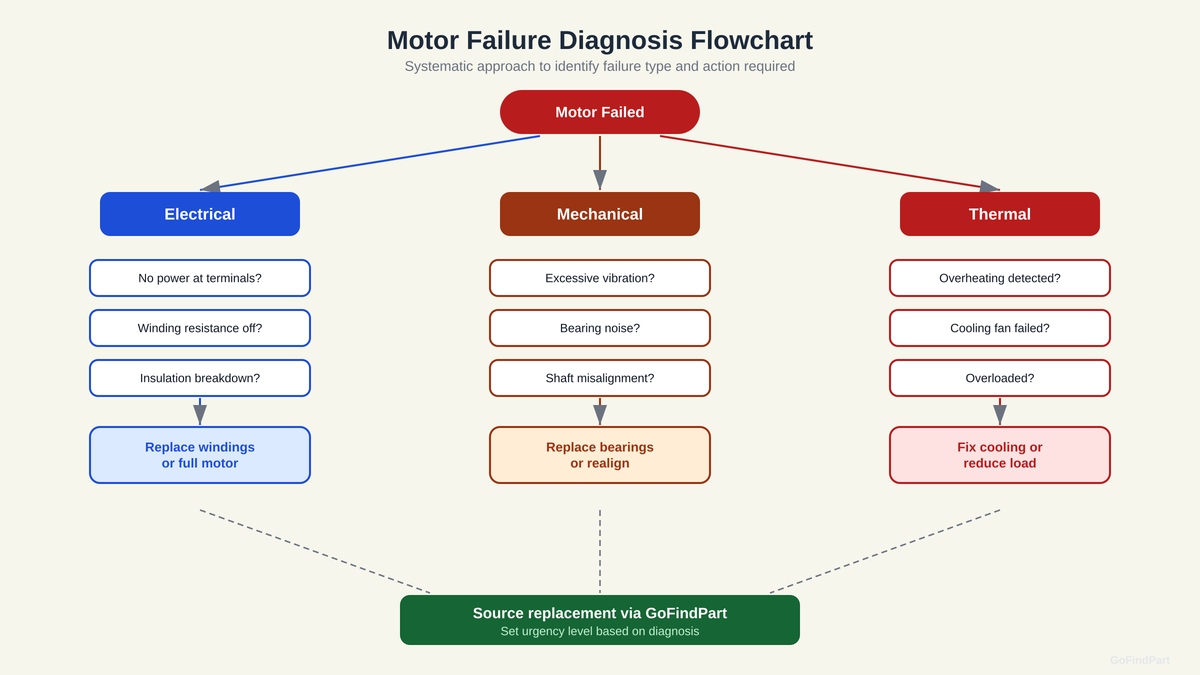
The first decision you face is critical: can this motor be repaired on-site, or does it need a full replacement? Making the wrong call costs hours. This checklist helps you diagnose quickly and take the right action.
Step 1: Safety and Isolation
Isolate the motor electrically at the main disconnect. Lock out and tag out. Do not rely on a soft stop or VFD disable — fully disconnect the power supply. Allow the motor to cool if it has been running. Failed motors can reach surface temperatures exceeding 150 degrees Celsius.
Warning
Step 2: Diagnose the Failure Mode
Electrical failure: Check for tripped overloads, blown fuses, or earth fault indicators. Measure insulation resistance with a megger — readings below 1 megohm indicate winding failure. Check for phase imbalance at the motor terminals.

Mechanical failure: Rotate the shaft by hand. Does it turn freely? Grinding or rough spots indicate bearing failure. A shaft that will not turn at all suggests seizure or foreign object damage. Check for play in the bearings by rocking the shaft laterally.
Overheating: Discolouration of the paint or varnish indicates sustained overtemperature. This can be caused by overloading, poor ventilation, or winding degradation. If the motor is undersized for the application, a like-for-like replacement will fail again.
Step 3: Repair or Replace?
For motors under 5 kW, replacement is almost always faster and more cost-effective than rewinding. Rewinding takes days to weeks, and the rewound motor may not perform as well as the original. For motors over 15 kW, rewinding becomes more economical, but you still face lead times.
If the failure is purely mechanical — a failed bearing with no winding damage — an on-site bearing replacement may be the fastest option. But if there is any sign of electrical failure (burnt insulation smell, low megger readings, visible winding damage), replacement is the safer choice.
Step 4: Capture the Motor Specifications
Record the nameplate data: manufacturer, frame size, power rating (kW), speed (RPM), voltage, frequency, mounting type (B3 foot, B5 flange, B14 face), shaft diameter, and IP rating. If the nameplate is damaged, measure the frame dimensions and shaft diameter physically.
Include the driven equipment in your request — a motor for a centrifugal pump has different starting torque requirements than one for a conveyor. This helps sellers recommend the right replacement if an exact match is not available.
Need a Replacement Motor?
Post your motor specifications and get offers from verified suppliers. Include nameplate photos for faster matching.
Post a Request

