


One all-in price per offer means every comparison is like-for-like. When three sellers quote for the same part, the numbers in front of you are the numbers you would actually pay — not starting points for a negotiation, and not quotes that grow once handling charges appear on the invoice.
When you buy an industrial part from a traditional distributor, the price you pay includes a markup that is invisible to you. Industry estimates place typical distributor markups between 30 and 60 percent, depending on the part category, urgency, and how captive the buyer is to that particular supplier.
You never see this markup. It is baked into the quoted price. You have no way of knowing whether the £500 bearing you just bought cost the distributor £250 or £400. This opacity is not accidental — it is the business model. And it has survived for decades because buyers had no practical way to compare prices from multiple suppliers simultaneously.
The Problem with Hidden Markups
Hidden markups create several problems that go beyond the obvious cost issue:

You cannot benchmark. Without knowing the actual market price for a part, you have no way to evaluate whether your current supplier is competitive. You are making procurement decisions based on trust and habit rather than data.
Urgency tax. When you need a part urgently, some distributors increase their markup further because they know you have no time to shop around. The very situation where you need the most help is when you pay the most premium.
No incentive to improve. When margins are hidden and competition is limited, there is no market pressure driving efficiency or better service. The distributor has no reason to improve delivery times, expand stock, or invest in technology.

How Transparent Pricing Works
GoFindPart takes a fundamentally different approach. Every offer you receive shows a single all-in price for the part — the price you see is the price you pay, with delivery and VAT itemised clearly at checkout and nothing else added on top. There are no subscription fees, no listing fees, and no minimum order values. Sellers, for their part, see exactly what they will be paid before they submit an offer.
Note

Because multiple sellers compete on each request, prices are driven by genuine market competition rather than whatever a single distributor decides to charge. Each seller prices from their actual cost plus their desired margin, knowing their offer will sit directly alongside rivals'. You see multiple offers, compare them on price, delivery, and seller rating, and choose.
The Mathematics of Transparency
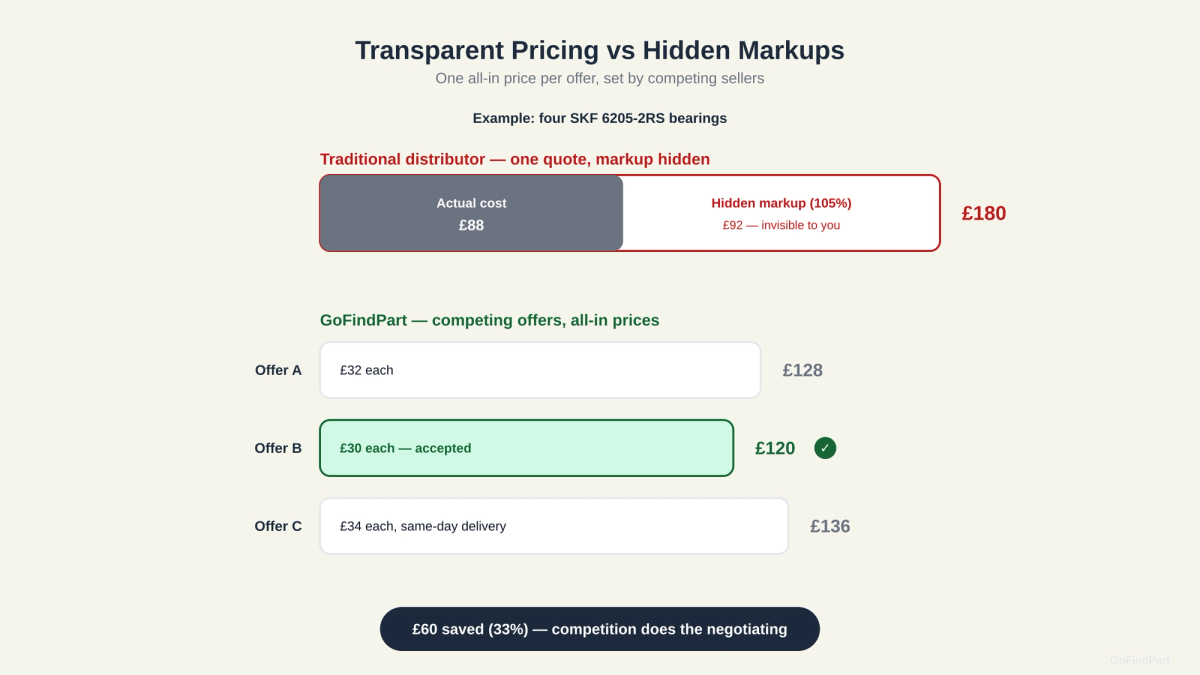
Consider an example. A buyer needs four SKF 6205-2RS bearings. A traditional distributor quotes £45 each (£180 total). Their actual cost is £22 per bearing — a 105% markup. The buyer has no way to know this.
On GoFindPart, multiple sellers compete for the same order. Offer A comes in at £32 per bearing, all-in. Offer B at £30. Offer C at £34 but with same-day delivery. The buyer selects Offer B at £30 each — £120 total, a £60 saving (33%) against the distributor quote — while the seller still earns a healthy margin over their cost. Competition did the negotiating.
This is not a race to the bottom. The seller in this example is making a reasonable margin. The buyer is getting a fair market price. The only losers are the inefficiency and opacity that the traditional model depends on.
See the Real Price
Post a request and compare transparent offers from multiple sellers. No hidden markups.
Post a Request

