
Reverse auctions are not a race to the bottom. Buyers can see seller ratings, reviews, and tier status alongside the price. Quality sellers with strong track records consistently win business even when they are not the absolute cheapest option, because buyers value reliability.
If you have ever spent an afternoon phoning five distributors for a single bearing, you already understand the problem that reverse auctions solve. Traditional procurement is sequential and time-consuming: you identify a supplier, request a quote, wait, follow up, compare, negotiate, and eventually place an order. Reverse auctions compress this entire process into minutes.
In a reverse auction, the buyer posts a detailed request for a specific part. Multiple verified sellers then compete to win the business by submitting their best offers. The buyer sees all offers transparently — price, delivery time, seller rating — and selects the best one. It is called a reverse auction because the price typically goes down as sellers compete, rather than up as in a traditional auction.
How a Reverse Auction Works on GoFindPart
The process is designed to be fast and transparent. Here is what happens from the moment you post a request:
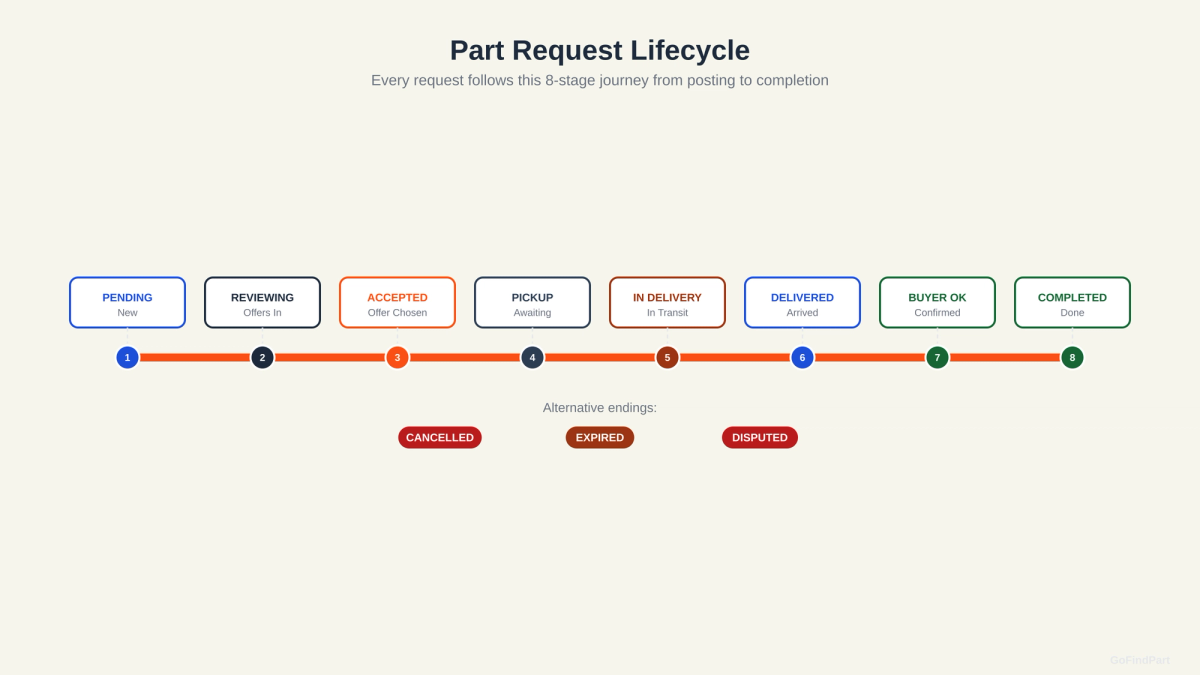
You post a part request. Include the part number, quantity, specifications, and your urgency level. The more detail you provide, the more accurate the offers you will receive.

Sellers are notified in waves. GoFindPart's notification system contacts relevant sellers based on their categories, location, and tier. Higher-tier sellers with proven track records are notified first, ensuring you get quality offers quickly.
Offers arrive competitively. Because sellers know they are competing against other suppliers, they submit their most competitive prices from the start. There is no room for inflated opening quotes followed by slow negotiation.
You compare and accept. Review all offers side by side. Consider price, delivery speed, seller rating, and any notes the seller has included about condition or compatibility. Accept the offer that best fits your needs.
What a strong request looks like. Part: SKF 6205-2RS deep groove ball bearing. Quantity: 4. Urgency: HIGH. Key specifications: 25mm bore, 52mm outer diameter, 15mm width. Notes: sealed variant required, no open bearings. Delivery preference: collection from supplier or same-day courier.
Every line in that example does a job: the part number lets sellers check stock instantly, the dimensions catch transcription errors, and the notes rule out near-miss offers before they are made.
Why Reverse Auctions Create Better Pricing
The economics are straightforward. When a single buyer contacts a single supplier, the supplier has no competitive pressure to offer their best price. They quote what the market will bear, often with a comfortable margin built in.
In a reverse auction, the supplier knows that four or five other sellers are submitting offers for the same request. This competitive pressure drives prices down naturally, without any negotiation from the buyer. Research consistently shows that reverse auctions achieve 10 to 25 percent savings compared to traditional RFQ processes for industrial components.
Note
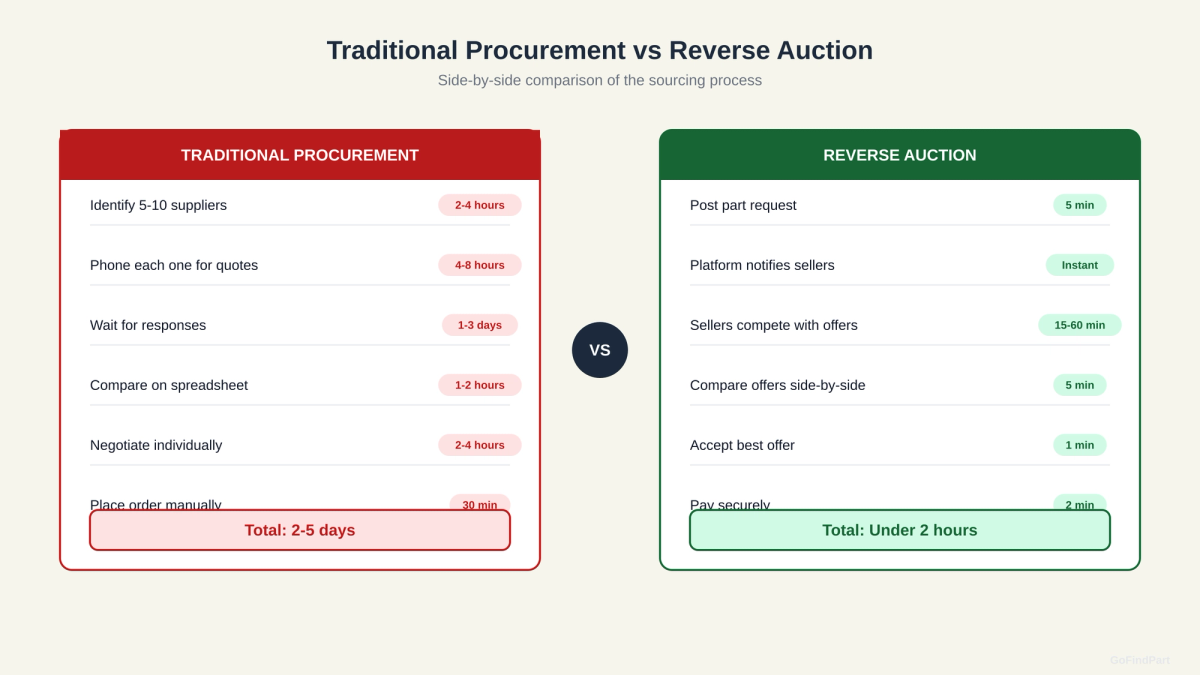
Reverse Auctions vs Traditional RFQ
The traditional RFQ process involves contacting suppliers individually, waiting for each to respond, compiling quotes in a spreadsheet, and then negotiating. For a single part, this typically takes one to three days. For an urgent part, it can still take hours of phone calls.

A reverse auction achieves the same outcome — multiple competitive quotes from verified suppliers — in a fraction of the time. For a CRITICAL request, every wave of seller notifications goes out within 15 minutes of posting; for HIGH urgency, within 25 minutes. The suppliers who can help see your request almost immediately, instead of one at a time as you work through a call list. The time saving alone justifies the approach for any procurement team managing frequent or urgent part requests.
The transparency is equally valuable. In a traditional RFQ, you never know whether a supplier has given you their best price. In a reverse auction, you can see exactly where each offer sits relative to the competition. This transparency builds long-term trust and eliminates the adversarial negotiation dynamic that plagues traditional procurement.
Try a Reverse Auction
Post your first part request and see competitive offers from verified suppliers. No subscription required.
Post a Request

