
The adoption of payment protection in B2B transactions mirrors what happened in B2C e-commerce 15 years ago. Consumers were initially reluctant to buy from unknown online sellers until platforms introduced buyer protection. The same psychological barrier exists in B2B, and payment protection addresses it in the same way.
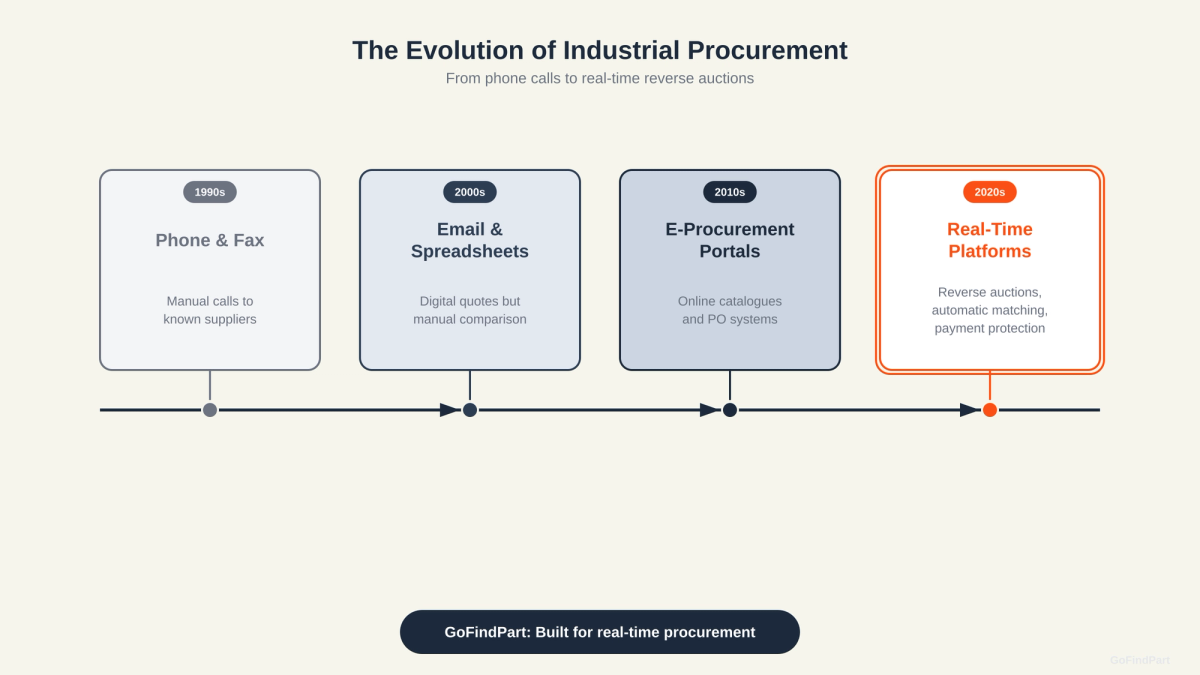
Industrial parts procurement in the UK is undergoing its most significant transformation in decades. The combination of digital procurement platforms, payment protection, and reverse auction models is challenging the traditional distributor-dominated supply chain that has operated largely unchanged since the 1970s.
This shift is being driven by three converging factors: buyers demanding faster sourcing and transparent pricing, sellers seeking access to a broader customer base, and technology making it possible to connect the two sides efficiently at scale.
The Rise of Digital Procurement Platforms
UK manufacturers are increasingly turning to digital platforms for MRO (maintenance, repair, and operations) procurement. The reasons are practical rather than ideological. When a production line is down and a critical part is needed in hours, phoning five distributors sequentially is simply too slow. A platform that broadcasts the request to dozens of qualified suppliers simultaneously and returns competitive offers within minutes solves a real operational problem.

This is not about replacing relationships — many buyers will continue to maintain preferred supplier lists. It is about having an alternative channel for urgent and ad-hoc procurement that the traditional model handles poorly.
Payment Protection Changes the Trust Equation
One of the biggest barriers to digital procurement in B2B has been trust. How do you pay a supplier you have never met for a £5,000 part? Historically, the answer was pro-forma invoice and hope for the best, or insist on 30-day terms that the supplier would not agree to for a new customer.

Payment protection resolves this deadlock. The buyer's payment is secured but not released until delivery is confirmed. The supplier knows the funds are committed, so they ship promptly. Both parties transact safely without any prior relationship. This removes the trust barrier that has historically made it difficult for buyers to diversify their supplier base.
Note
Reverse Auctions Gain Traction

Reverse auctions have been used in enterprise procurement for years, but they are now becoming accessible to mid-market manufacturers and even smaller operations. The model — buyer posts a request, sellers compete to offer the best deal — is particularly well-suited to MRO procurement where parts are standardised and multiple suppliers can fulfil the same request.
The competitive dynamic consistently delivers savings of 10 to 25 percent compared to single-source procurement, while simultaneously reducing sourcing time from days to hours. For procurement teams under pressure to reduce costs and improve availability, this combination is compelling.
What This Means for Sellers
For industrial suppliers, digital platforms represent both an opportunity and a challenge. The opportunity is access to a national buyer base without the overhead of a large sales team, showroom, or extensive marketing. A specialist bearing supplier in Birmingham can win business from a buyer in Glasgow who would never have known they existed.
The challenge is that competition is more visible. On a platform, your offer sits alongside four others. Price, delivery time, and reputation are all transparent. Sellers who thrive in this environment are those who combine competitive pricing with fast response times and reliable delivery.
Be Part of the Change
Whether you are a buyer seeking faster sourcing or a seller looking for new customers, GoFindPart connects you with the UK industrial parts market.
Get Started

